




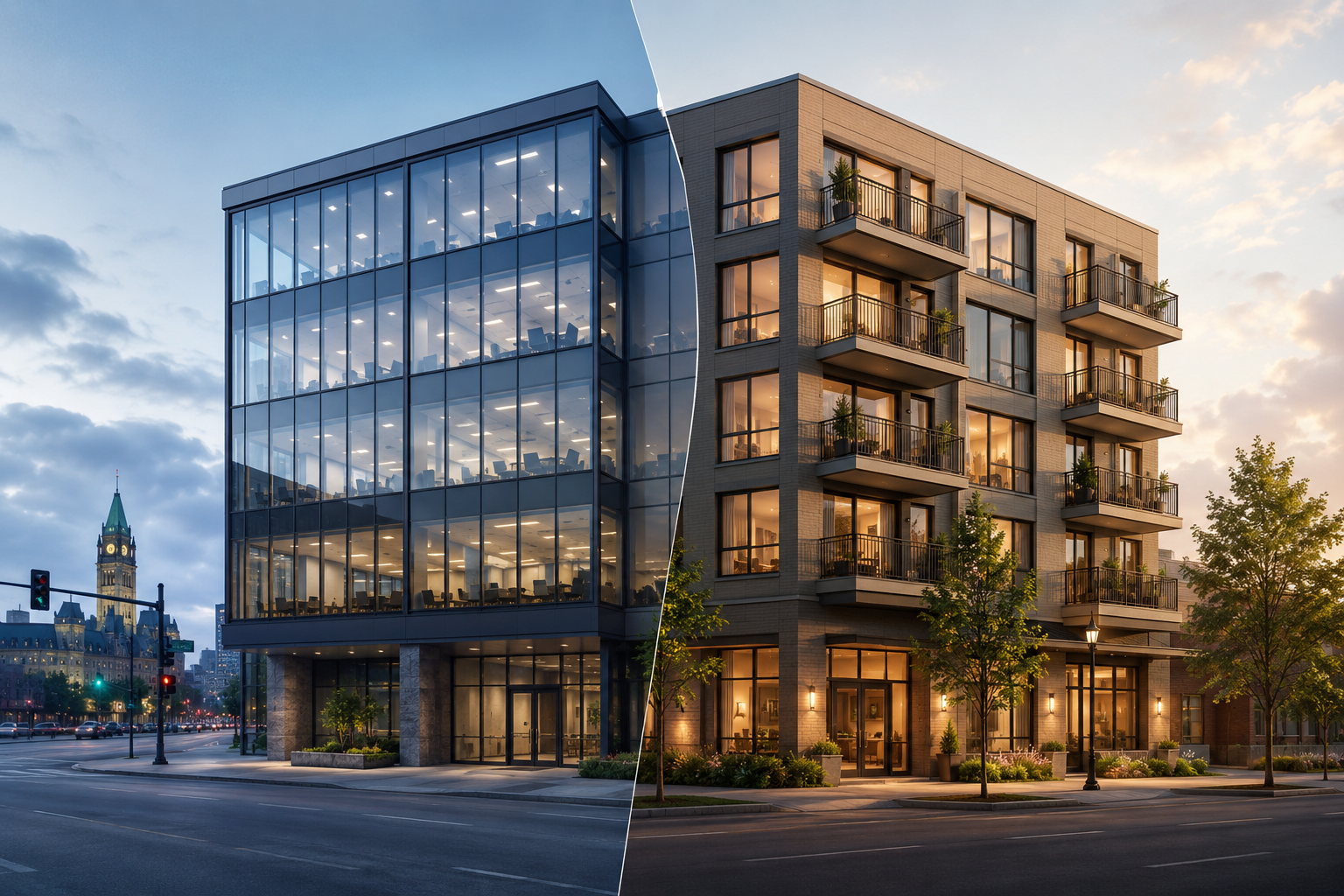
Ottawa's changing office landscape is raising an important question for commercial property owners and investors: when does an office building become more valuable as something else?
Across Ottawa, aging and underused office buildings are increasingly being considered for residential conversion — a trend that could remove obsolete office inventory, add housing and bring more residents into employment-focused areas.
Why is Ottawa looking at conversions?
Ottawa-Gatineau has approximately 101 million square feet of office inventory, with roughly 7.4 million square feet vacant.
Over the past 12 months, the market recorded approximately 1 million square feet of negative net absorption, while only about 73,600 square feet is currently under construction.
For some older properties facing prolonged vacancy or significant upgrade costs, continued office use may no longer represent the property's highest and best use.
Ottawa Is Already Turning Offices Into Homes:
Office-to-residential conversion is already happening in Ottawa. According to the City of Ottawa, more than 700 residential units were created through office-to-residential conversions between 2013 and 2022.
Examples include The Slayte at 473 Albert Street, where a former government office building was converted into 158 rental apartments, as well as projects at 360 Laurier Avenue West and 200 Elgin Street. In Kanata North, a former office tower is also being converted into 115 residential units.
Not Every Office Building Is a Candidate Conversion is not a universal solution. Floorplate depth, window placement, ceiling heights, plumbing, elevators, mechanical systems and building codes can all affect feasibility.
Location is also critical. Access to transit, services, employment, retail and public amenities will influence residential demand and long-term value. The City has taken steps to streamline the planning process, but conversions can still require significant investment in construction, design, approvals, financing and code upgrades.
What Should Owners Consider? Before pursuing a conversion, owners should compare it with other options, including continued office use, repositioning or redevelopment.
Key questions include:
Is the building physically suitable for residential use? Would conversion create more value than renovating or repositioning the property? What would the total project cost be? Would the location support residential demand? What approvals or incentives may be available? How would the project affect current income and financing?
Office-to-residential conversion may offer a compelling strategy for certain Ottawa properties, but it is not a one-size-fits-all solution. The strongest opportunities are likely to be buildings where office demand is limited, the layout supports efficient residential design, the location can attract tenants and the costs leave room for an appropriate return. For owners considering their options, the first step is to compare the property's realistic alternatives and determine which strategy offers the strongest risk-adjusted potential.
Check out this article next